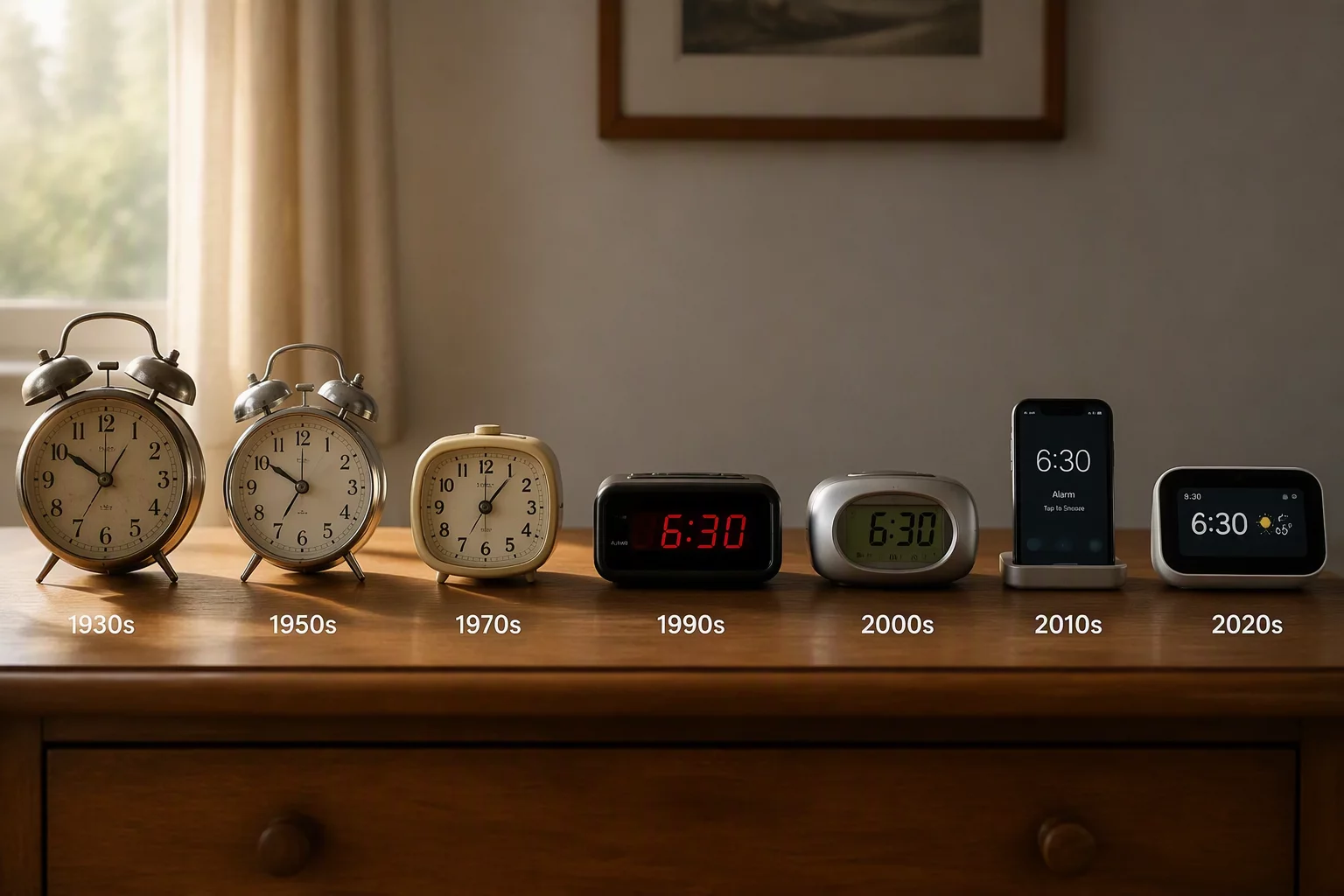
From Water Dripping to Brass Bells: The Earliest Wake-Up Systems
Long before electronic buzzers disrupted morning quietude, ancient civilizations engineered clever hydraulic and mechanical systems to announce dawn. The ancient Greeks devised water clepsydras with siphons that pushed air through whistles, waking philosophers before dawn lectures. As mechanical clockwork advanced in late medieval Europe, monastery bell towers took over the task, ringing strict prayer hours across sleeping towns. By the late 18th century, Levi Hutchins created an ingenious mechanical clock in New Hampshire that sounded a firm bell exclusively at 4:00 AM, matching his rigorous morning routine and sparking a movement toward individual morning timekeeping.
The Industrial Shift: Mechanical Bells, Flip Clocks, and Quartz Precision
Industrialization demanded collective punctuality across growing factory floors and railway networks. In 1847, French inventor Antoine Redier patented the first adjustable mechanical alarm clock, granting individuals control over their rising hour. Twin-bell mechanical alarms quickly became standard fixtures on nightstands worldwide, known for their unmistakable metal clatter and robust spring-driven balance wheels. The mid-twentieth century introduced synchronous electric motors, illuminated flip displays, and later, ultra-steady quartz crystals. Today, acoustic alarms combine precision mechanical heritage with harmonious chime resonance, prioritizing gentle sleep transitions over jarring awakenings.
Key Milestones in Wake-Up Technology
The gradual transformation of awakening mechanisms mirrors humanity's shifting relationship with scheduled work, circadian health, and bedroom acoustics.
- 4th Century BCE: Water-driven clepsydras with acoustic whistles in ancient Athens.
- 1847: Antoine Redier invents the adjustable mechanical alarm mechanism.
- Mid-20th Century: Electric flip numbers, twin-bell resonators, and transistor quartz oscillators.
Horological Movement Characteristics
Comparing classical mechanical alarm assemblies with modern precision acoustic desk timepieces.
| Coverage Term | 2-Year Canadian Warranty |
|---|---|
| Supported Calibers | Mechanical Escapement & Silent Quartz |
| Regional Facility | Calgary Horology Center, Canada |
Care & Guidance FAQs
In industrial Britain and North America, communities employed professional 'knocker-ups' who used long poles or peashooters to tap bedroom windows until workers woke for early morning factory shifts.
Mechanical chimes generate organic acoustic soundwaves and tactile presence without blue light emissions, protecting natural melatonin production and encouraging calmer morning routines.
No comments yet. Be the first to share your thoughts on the history of alarm clocks.